
What is Eminent Domain?
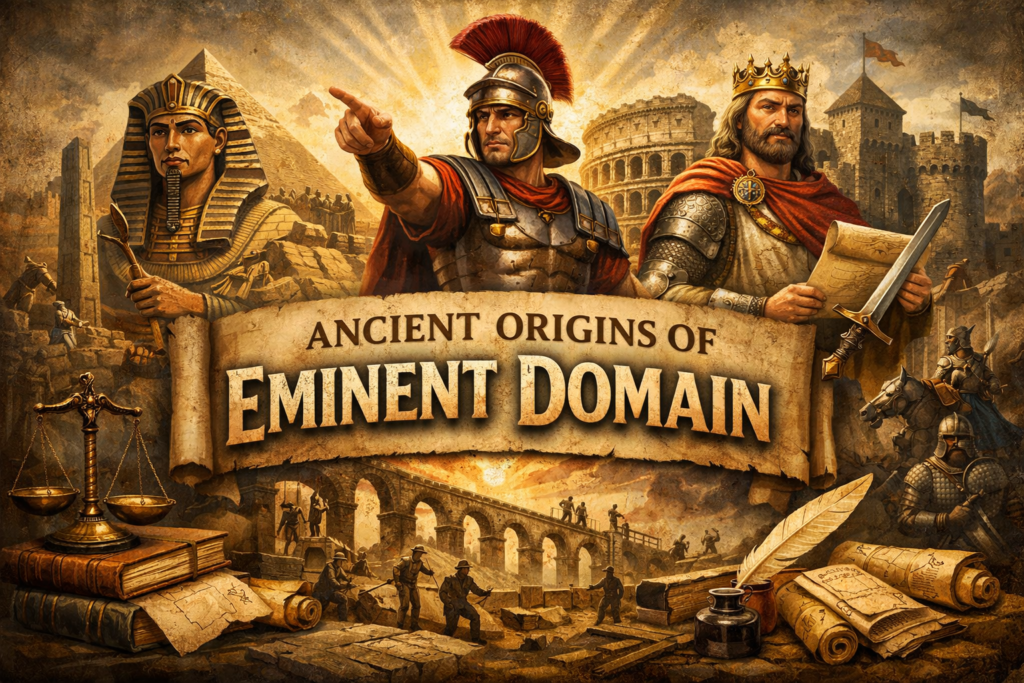
If you’ve recently learned that your property may be affected by eminent domain, you’re probably wondering: Where did this power even come from? And why does the government have the right to take private land at all?
The truth is that eminent domain isn’t a modern invention. It’s a very old legal concept—one that has evolved over thousands of years to balance public needs with private property rights. Understanding its origins can help you see how today’s laws developed and why you do have rights and protections.
Where It All Started: Ancient Civilizations
In the earliest societies—Egypt, Mesopotamia, and other ancient kingdoms—land was considered part of the ruler’s domain. Kings and pharaohs could take land for irrigation canals, temples, or military projects without asking permission or offering compensation.
This wasn’t “eminent domain” as we know it today, but it established the basic idea: Governments sometimes need land to build things that benefit the public.
Rome: The First Steps Toward a Legal System
The Roman Empire is where eminent domain begins to look familiar.
Rome built massive public works—roads, aqueducts, fortifications—and sometimes needed private land to do it. Roman authorities utilized some form of compensation, such as tax relief, when land was taken.
This is one of the earliest examples of the principle that guides modern law: When the government takes private property for public use, the owner should be compensated.
Medieval Europe: Property Rights Begin to Emerge
During the Middle Ages, kings still had broad power to take land, especially for military needs. But over time, people pushed back.
The Magna Carta (1215) was a turning point. It limited the king’s authority and introduced the idea that property couldn’t be seized arbitrarily. This helped shape the future concept of due process—a protection that still matters today.
Early Modern Thinkers: Compensation Becomes Essential
By the 1600s, legal scholars began arguing that governments could take land for public use—but only if they paid for it.
The most influential voice was Hugo Grotius, who wrote that taking private property without compensation was unjust. His ideas helped form the foundation of modern eminent domain law.
How This History Shapes Your Rights Today
When the United States was founded, the framers didn’t start from scratch—they built on centuries of legal tradition. That’s why the Fifth Amendment includes the Takings Clause:
“…nor shall private property be taken for public use, without just compensation.”
This single sentence reflects thousands of years of evolution—from ancient kings to modern constitutional law.
And it means something important for you:
You have rights. You have protections. You have options.
Eminent domain may be an ancient concept, but today it must follow strict rules. Governments must:
- Prove the project serves a public use
- Follow due process
- Provide just compensation
- Treat property owners fairly
If any of those steps are mishandled, you have the ability to challenge the process.
Why This Matters If You’re Facing a Taking Today
Understanding the origins of eminent domain helps you see that:
- The power itself is old—but modern protections are strong
- You’re not at the mercy of the government
- You have legal rights that didn’t exist for most of human history
- You deserve fair treatment and full compensation
And most importantly: You don’t have to navigate this alone.
For a free, no obligation discussion about your rights, contact Mark R. Fox, at MFoxLawFirm. Your experienced Eminent Domain Attorney. (213) 755-6801 or MFox@MFoxLawfirm.com.